Don't pay that medical bill yet.
Regular price $67. Special launch price.

One woman I spoke with got the bill 14 months after her daughter was born. $3,247. From an anesthesiologist she'd never met.
She called the hospital. They told her to call the anesthesia group. She called the anesthesia group. They told her to call insurance. She called insurance. They told her to call the hospital.
She held for 47 minutes on the last one. When someone finally picked up, they said the claim had already been processed and there was nothing more they could do. She believed them.
By the third month, a pattern showed up. Everyone she spoke with sounded certain, and no two of them agreed on what to do. Every call ended with the bill still on her table.
Maybe your bill is $800. Maybe it's $28,000. The amount changes. The feeling doesn't.
Every day looked like this:
- The mail came, and she checked the return addresses before opening anything.
- Her credit score sat in the back of her mind whether she was thinking about it or not.
- Unknown numbers went to voicemail because she didn't know who they were.
- She lost sleep the week the second notice arrived.
- Underneath all of it, a quieter feeling. The one nobody puts on a bill. The sense that the system was happening to her and she couldn't get on the other side of it.
She'd tried everything the people on the phone suggested:
- She'd called the billing department three times.
- She'd asked for a payment plan and was told the balance was too small to qualify.
- She'd requested a supervisor and been put back in the queue.
- She'd filled out the hardship application she found on the hospital's website.
- She'd waited six weeks for a response that never came.
- She'd called back and started over.
The eleventh call was from her kitchen table, coffee going cold. Halfway through the hold music, she put the phone down. Not because she gave up. Because she realized she was doing the same thing every time and expecting a different result.
She hadn't lost this fight because she wasn't trying hard enough. She'd lost it because nobody had ever shown her the rules.
The moment everything started making sense.
After hundreds of stories like hers, one pattern kept surfacing.
The one that stayed with me was a Reddit thread I read at 1 a.m. A woman had been fighting a $756 emergency room bill for six months. She'd used every polite scripted phrase in the book and gotten nowhere. Then a former hospital billing employee posted one line under her post. She used it on her next call. The bill went from $756 to $151.
The exact wording matters. It's in the toolkit. But that's not the point of the story.
The point is that the phrase worked because it named something specific. It shifted the call from "please help me" to a documented request the rep had to route to someone with authority to act. The rules had been sitting there the whole time. Nobody had shown her which one to invoke.
I read every one of her responses in that thread. Then I read court records, hospital financial policies, federal law under 501(r), and hundreds more patient stories.
One thing came into focus. It's the sentence I want you to sit with:
The runaround isn't an accident. It's the strategy.
Fewer than 1% of patients ever appeal a denied medical claim. Of the ones who do, 40 to 60% win. That gap is the whole game.
The system is built to make you tired. Not because a villain in a boardroom decided that. Because the process rewards the person who never has to answer for a "no." The longer they can keep you calling the wrong number, the higher the odds you stop calling at all.
Most medical bills contain errors most patients never find.
The Medical Billing Advocates of America has reported that 80% of medical bills contain at least one error. Duplicate charges. Services never received. The wrong billing code entered by a tired clerk on a Tuesday. Charges for a private room when you were in a shared one. Anesthesia billed by time when the surgery ran shorter than expected.
The errors are almost never visible on the summary bill. They only show up when you request the itemized version, which most patients don't know to ask for.
Different bills require different fight paths.
Not every bill is the same problem. A billing error needs a written dispute. A bill you can't afford needs a negotiation. Financial hardship qualifies you for charity care under the same federal statute that gives nonprofit hospitals their tax exemption. An insurance denial needs a formal appeal filed to a specific review level. A bill that's already in collections needs a 48-hour move before it touches your credit report.
The reason "trying everything" so often fails is that the reader is using the wrong path for the bill in front of them. The moves that work on one type of bill can't touch the other four.
But the most damaging mistake of all:
Most patients quietly kill their own case without ever knowing they did it. They make verbal-only requests the rep isn't required to log. They miss deadlines they were never told about. They fill out the wrong application. They take the first denial as the final answer and never file the escalation that would have overturned it.
There's no single moment where the mistake is obvious. Just a slow drift toward "there's nothing I can do," when in almost every case there was.
So I built the system I wish she'd had at call one.
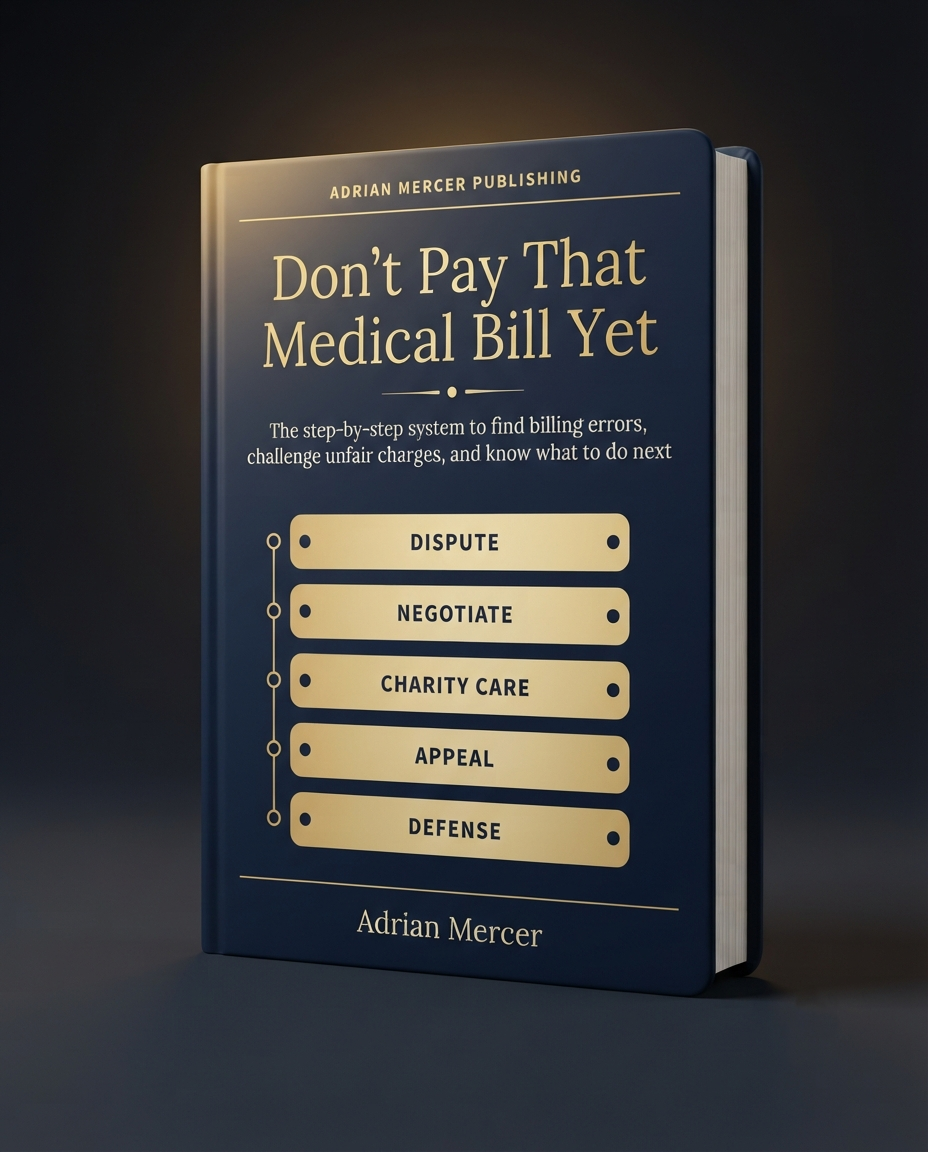
I stopped trying to memorize everything. I put a system together instead. Nine tools. Each one built for a specific move. I call it "Don't Pay That Medical Bill Yet."
When you open it, here's what you'll be able to do:
- Know which type of medical bill you're dealing with in under five minutes, using a diagnostic that tells you which of the five fight paths yours is on and where to start.
- Catch billing errors most patients never notice, using a line by line checklist that walks you through the seven most common mistakes hospitals make on their bills.
- Apply for charity care the right way the first time, using the specific documents and phrasing that keep hospitals from rejecting your application on a technicality.
- Walk into your next phone call knowing what to say, using a script that tells you what to open with, what the rep is likely to say back, and how to respond when they do.
- Know what to do in the first 48 hours if your bill has gone to collections, before it hits your credit report and stays there for seven years.
You'll use this toolkit even if you've called ten times, been denied twice, and stopped believing anything is going to work. If that sounds familiar, I built it for you.
Regular price $67. Special launch price.
Who this is for.
It's for you if:
- You just got a confusing medical bill.
- You've already tried calling and got nowhere.
- You're worried about collections or your credit.
- You don't want more advice. You want a plan.
It isn't for you if:
- You want someone else to make the phone calls and send the letters.
- You expect a guaranteed dollar figure reduction without doing the work yourself.
- You're looking for legal representation instead of a self-help system.
Why most people never reduce their medical bills.
The five mistakes that quietly destroy your leverage before you even start.
Nobody ever told them the rules. Here are the five that show up most, and what each one costs you.
The summary bill they mail you doesn't show the individual line items. It shows a total, a due date, and a phone number. If you pay from the summary, you're paying without ever seeing what you were charged for.
Most of the billing errors that get patients big reductions are hiding in the itemized version. The itemized bill is a document you have the right to request. Nobody at the hospital is going to remind you it exists.
The Billing Error Detection Checklist inside the toolkit is what you run once the itemized bill arrives. It walks you through the seven mistakes that show up most, with what each one looks like on the page.
The rep on the call is not the person who processes your account. What you agreed to verbally does not follow the call into anyone's system unless someone writes it down and enters it. If it isn't in writing, it doesn't exist.
Patients lose promised reductions this way every day. There's no record of the promise to point to when the next bill arrives at the higher amount.
The Itemized Bill Request pack gives you the exact wording, format, and delivery method to build a paper trail from the first envelope. The phone scripts come with the instruction to follow up every call with a written confirmation the moment you hang up.
A billing error, an unaffordable balance, a charity care case, an insurance denial, and a collections account are five different fights. Each one has a different form, a different deadline, a different person on the other end, and a different sentence that starts the process.
The most common way patients lose is doing something reasonable on the wrong path. Asking for a payment plan when the bill has coding errors. Filing an appeal for a bill that should have gone through charity care. Both efforts feel like fighting. Neither one moves the bill.
The Bill Type Diagnostic sits at the front of the toolkit for this reason. A short set of questions and a decision tree that lands you on the right path in under five minutes.
Insurance appeals have windows. So do charity care applications and collections defenses. The hospital rarely volunteers those dates on the summary bill. They're in the letters that come later, on page two, in a paragraph most people read once and put aside.
If you miss the window, the strongest options quietly close and nothing on the outside of the envelope tells you they did.
The 48-Hour Action Plan tells you exactly what to do in the first two days after any bill lands so nothing gets closed off. The Progress Tracker and Timeline holds every deadline, every call, and every letter in one place after that.
A first-line rep is not who decides whether a claim gets reprocessed or a hardship application gets reconsidered. That call center exists in part to end the conversation.
In the appeals data, the patients who file the internal appeal and then push it to external review win somewhere between 40 and 60% of the time. Almost nobody ever files. The first "no" is where the runaround goes to work. The way through is a specific ask, a specific person, and a specific escalation.
The Negotiation Framework tells you the phrase to open with, who to ask for when the first rep says no, and what to say at each level. The Insurance Appeal Process walks you through the internal appeal and the external review that forces the second look.
You don't need to remember any of this.
That's the point. The toolkit remembers it for you. You open it. Follow the steps. Know what to do next.
Regular price $67. Special launch price.
What you get.
The complete Don't Pay That Medical Bill Yet toolkit. Nine tools you'll open, follow, and use. Checklists, decision trees, templates, and scripts. Built for someone with a bill on their kitchen table, not a textbook on their lap.
The Bill Type Diagnostic. A handful of questions and a decision tree that lands you on one of the five fight paths in under five minutes.
The 48-Hour Action Plan. What to do in the first two days after any medical bill lands, so nothing you need later gets closed off.
The Itemized Bill Request pack. The wording, the format, and the delivery method that build a paper trail from the first envelope.
The Billing Error Detection Checklist. The seven most common mistakes to look for on any itemized bill, with what each one looks like on the page.
The Negotiation Framework. The phrase that opens the negotiation. Who to ask for when the first rep says no. What to say at each level.
The Charity Care and Financial Assistance Guide. How to apply the right way the first time. The documents to include. The income thresholds hospitals don't publicize.
The Insurance Appeal Process. How to file the internal appeal, what to say, and the escalation that forces an external review.
The Collections Defense Basics. What to do in the first 48 hours if your bill has already gone to collections, before it can touch your credit.
The Progress Tracker and Timeline. One page that holds every deadline, every call, and every letter so nothing slips.
Everything works together.
You don't have to figure out what comes next. The toolkit already has.
You'll also get these bonuses today.
Bonus #1: The EOB Decoder. A one-page side by side of a real EOB and a real bill with every element labeled. You'll know at a glance what's a demand for payment and what isn't.
Bonus #2: The Collections Kill Switch. A separate 48-hour emergency guide with its own scripts, letters, and action plan. The written request that stops the process. The deadline it has to be sent by. What to do next.
Bonus #3: The Medical Debt Credit Shield. The medical debt credit reporting rules changed in 2025. Most patients still don't know how the new protections work. This short guide walks you through what qualifies and how to invoke it, so a bill that's already been reported can come off.

One corrected charge or negotiated reduction could cover the cost of the toolkit many times over.
Regular price $67. Special launch price.
Before and after.
Before:
- The bill has been sitting on the kitchen table for weeks, and every time you walk past it your stomach tightens.
- You've made call after call and gotten the same runaround, transferred back to a number you already tried.
- You're watching the mail for collections notices and refreshing your credit report every few days.
- You've tried the payment plan, the hardship form, the supervisor request, and none of it moved the number.
- Underneath it, the quieter feeling that the system is happening to you and you can't get on the other side of it.
After:
- You know which of the five fight paths your bill is on, and you have a step by step plan for that specific one.
- You have a plan for the first 48 hours and everything that follows, with deadlines mapped so nothing gets missed.
- You walk into every phone call already knowing what to say, who to ask for, and how to answer the first "no."
- You've run the itemized bill through the error checklist and caught what most patients never see.
- You've stopped feeling like the system is happening to you and started running the process yourself.
The 60-day clarity guarantee.
Still not sure? Open the toolkit. Run the Bill Type Diagnostic. Read your path. If you come away without a clear next step for your specific bill, email support within 60 days for a full refund.
This isn't a results guarantee. It's a clarity guarantee. It matches what the toolkit can actually deliver: knowing what to do next.
Get "Don't Pay That Medical Bill Yet" now.
While other people stay overwhelmed about a bill they don't understand, you'll have a system on the kitchen table and a next step already marked.
You'll know which fight you're in, and stop wasting energy on the wrong phone calls.
You'll spot the openings most patients never see, and move through the system with a plan instead of hope.
And when the next decision comes, you'll know what to do.
Instant access. Delivered as a downloadable PDF. Open it on your phone, or print the pages you need tonight.
The toolkit isn't changing. The launch price is.